
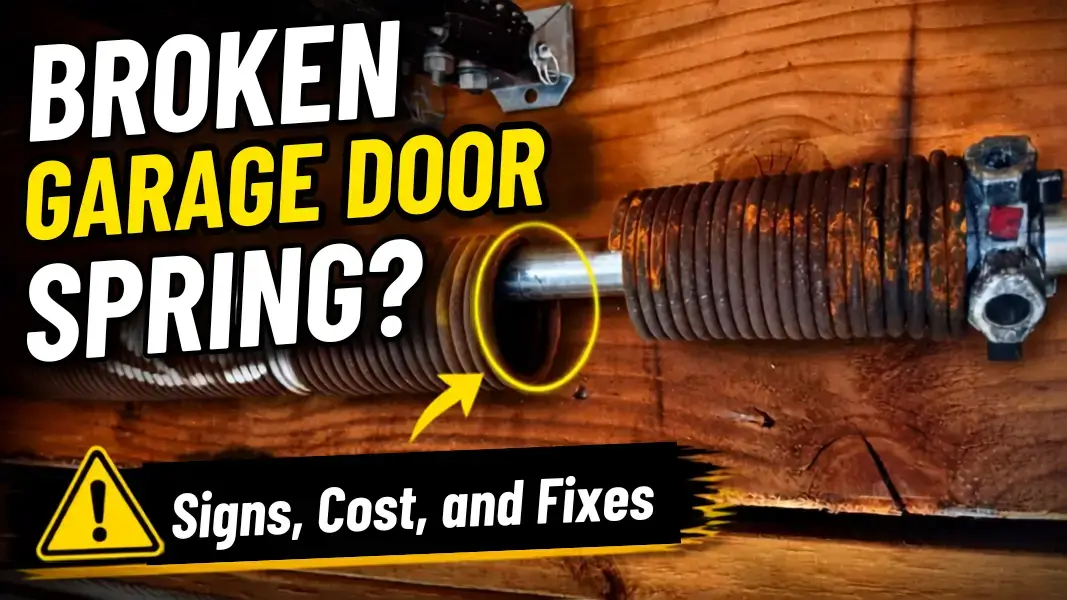
Broken Garage Door Spring? Signs, Cost, and Fixes
A broken garage door spring is one of the most common calls we get, and it usually announces itself loudly. Here is how to spot the warning signs, what a fix actually costs, and why this is one repair you should never attempt on your own.
The Warning Signs
The clearest sign is a loud bang from the garage, often described as a gunshot or an engine backfire. Springs break under full tension, and when they let go, the sound is sharp and sudden. If you heard this and the door will not open now, that is almost always a broken spring.
Before it fully snaps, a spring usually gives smaller warnings first. The door starts to feel heavier than normal when lifted by hand. It may open a few inches and stop, or the opener hums and strains but the door does not move at all. A door that rises crooked, faster on one side than the other, often means one spring has already weakened while the other still holds.
Take a look at the spring itself if you can see it safely from a distance. A visible gap or separation in the coil almost always confirms a break. On doors with two torsion springs, one may still look intact while the other has separated, so the door might still lift a little before you notice a problem. If you spot any of these signs, our team can inspect your springs and tell you exactly what condition they are in before anything gets worse.
Why Springs Wear Out
Torsion and extension springs both carry the full weight of the door, cycle after cycle, for years. Most residential springs are rated for around 10,000 cycles, roughly seven to ten years of normal use. Every open and close uses up a small amount of that life. Rust, extreme temperature swings, and a door that was never balanced correctly all shorten a spring’s lifespan further.
Cables often show stress right alongside a spring under strain, since the two systems share the load. If a cable near the bottom bracket looks frayed or loose, mention it to your technician when you call about a spring.
Why This Is Never a DIY Job
A fully tensioned spring stores enough energy to cause serious injury. The Consumer Product Safety Commission tracks thousands of garage door related injuries every year, and a large share involve springs and the tools used to wind or unwind them. This is not a job for a wrench and a YouTube video.
If you suspect a broken garage door spring, do not use the opener again. Do not try to lift the door by hand, and keep kids and pets away from the area. Unplug the opener so no one accidentally triggers it while the door is unbalanced. Wait for a professional. Do not try to find out how far you can push it.
What Replacement Costs
Most spring repairs for a single door run in the $150 to $350 range, though the exact number depends on spring type and whether one or both springs need to be replaced. Torsion springs generally cost a bit more than extension springs because of the specialized tools required to install them safely. A technician will also check the cables, drums, and door balance during the same visit, since a spring rarely fails in complete isolation.
Single doors typically use one or two torsion springs, while heavier double doors often need two that work together as a pair. When one spring fails, the other is usually close behind. It often makes sense to replace both at once, even if only one has snapped, so you avoid another service call in a few months.
An accurate quote means someone needs to look at the door in person. We can give you a straight answer on cost once we see the spring type and door size in person, instead of a rough guess over the phone.
Denver’s Effect on Spring Life
Denver’s wide temperature swings put extra stress on metal spring coils throughout the year. A spring that handles a mild fall morning fine can tighten up during a hard freeze, and that added strain speeds up fatigue on a spring that was already close to the end of its life. Dust and dry air add wear too, since grime works into the coil surface faster here than in wetter regions. Homes with older, unreplaced springs tend to see this show up as a sudden failure rather than a slow decline, often right when the first cold snap of the season hits.
A broken garage door spring rarely gives much warning once it truly lets go, which is why the early signs matter so much. If your door has felt heavier lately or you noticed a gap in the coil, do not wait for the loud bang to confirm it.
Call us at (833) 435-8883 and we will send a technician out to replace the spring safely and get your door back to normal the same day.
Broken Spring FAQs
What does it sound like when a garage door spring breaks?
Most people describe it as a loud bang, like a gunshot or a car backfiring. It happens because the spring releases all its stored tension at once. If you heard a sound like that and your door will not open, a broken spring is almost certainly why.
Can I open my garage door manually if the spring is broken?
You can try, but it will feel extremely heavy and can be dangerous without the spring supporting the weight. It is safer to leave the door closed and call a professional rather than force it open by hand.
How much does it cost to replace a garage door spring?
Most single-door spring repairs run about $150 to $350, depending on the spring type and whether one or both need replacing. A technician can give you an exact number once they see the door in person.
Can I replace a garage door spring myself?
It is not recommended. A tensioned spring can cause serious injury if it slips while you are working on it. This is one of the few garage door repairs that really does need a trained professional.
How long do garage door springs last?
Most residential springs are rated for about 10,000 cycles, which works out to roughly seven to ten years of normal use. Extreme temperature swings and an unbalanced door can shorten that lifespan.
Broken Spring Warning
A snapped spring under tension can hurt you. Don’t touch it.
Our Denver techs replace both spring types safely, same day.
24/7 emergency line · Parker & Denver metro