
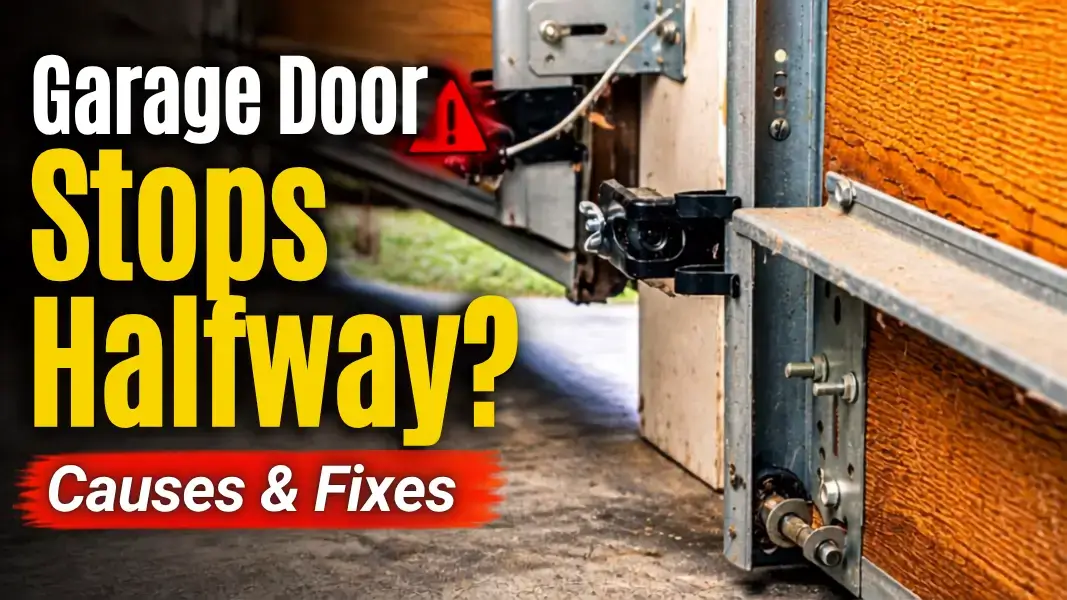
Garage Door Opens Then Stops Halfway in Denver Homes
A garage door that opens partway and then stops can leave your car stuck and your garage exposed. This is one of the most common calls we get from Denver homeowners, and most of the time the cause is easy to trace once you know where to look.
Visit Our Garage door services anytime for the full range of repair services we offer across Denver. Left alone, a stalled door also leaves your home exposed, since anyone can duck under a partly raised panel. Below we cover why a garage door stops halfway and what each cause means for your repair.
Common Reasons a Garage Door Stops Halfway
Most of the time, a garage door stops halfway because of one of five things: sensor trouble, wrong limit settings, worn tracks or rollers, weak springs or cables, or a fading remote signal. Each cause acts a bit differently, so the fix is not one size fits all.
The good news is that a few of these checks take only a couple of minutes. The bad news is that one or two of them are genuinely dangerous to handle yourself.
A fast way to narrow things down is to disconnect the opener and lift the door by hand. A properly balanced door should glide smoothly and hold its position on its own around chest height. If it feels heavy or drops back down, a spring problem is the likely culprit.
Sensor Problems
Every modern opener uses two small safety sensors near the bottom of the tracks. They send an invisible beam across the doorway. If anything blocks that beam, even a leaf, a toy, or built up dust, the door reads it as an obstacle and refuses to finish its cycle.
Denver garages collect a surprising amount of dust from dry air and nearby gravel roads. A quick wipe of both sensor lenses often solves the problem in minutes. If the lights on the sensors still blink or fail to line up, our sensor repair team can check the wiring and alignment for you.
Limit Setting Issues
The opener has limit switches that tell the motor how far to travel before it stops. Over time, vibration or a small bump can knock these settings off. When that happens, the opener may think the door reached full open long before it actually did, so it halts early.
This is a simple adjustment on most openers, though the exact steps vary by brand and model.
Worn Tracks and Rollers
Bent or dirty tracks force the door to fight resistance the whole way up. Old or cracked rollers add to that drag. Once the opener senses too much resistance, its safety feature kicks in and stops the door rather than risk burning out the motor.
A quick visual check along both tracks can reveal dents, gaps, or debris. If the door sounds rough while it moves or the rollers look worn, we can inspect and repair the tracks before the problem gets worse.
Denver’s swing between hot days and cold nights can tighten metal tracks just enough to add extra resistance. On a track that is already worn, that small change is sometimes all it takes to trip the opener’s safety cutoff.
Spring and Cable Trouble
Torsion springs carry almost the entire weight of the door. The opener is only built to guide it, not lift it. When a spring weakens, cracks, or breaks, or when a cable slips off its drum, the opener suddenly has to do a job it was never designed for. It strains, then stops.
This cause carries the most risk. A door that hangs on a weak spring or a loose cable can drop without warning, so we will always recommend our spring services over a DIY attempt for this one.
Remote or Wall Control Faults
Sometimes the door itself is fine and the signal is not. A weak remote battery, a worn wall button, or interference from another device can cut the command short mid cycle. Try new batteries or test the wall control before you assume a mechanical fault.
Interference sometimes comes from a neighbor’s opener on the same frequency, a new appliance, or LED bulbs plugged in near the unit. A spare remote or the wall button alone can help you find out where the signal actually fails.
What to Do When a Garage Door Stops Halfway
Never force a stuck door by hand, and do not pull the emergency release cord while the door is stopped midair. If a spring or cable looks like the issue, the stored tension makes this a job for a trained technician, not a weekend project.
Start with the easy checks: clean the sensors, look at the tracks, and test the remote. If the door still stops halfway after that, the problem is likely mechanical, and we can send a technician out through our opener services to find the exact cause.
Call (833) 435-8883 anytime you need a same day look at a Denver garage door that will not finish opening. Our team can diagnose the cause and get the door moving safely again.
Garage Door Stops Halfway: Your Questions Answered
Quick answers to the most common questions Denver homeowners ask when a garage door stalls mid-travel.
1 Why does my garage door stop halfway when opening? HalfwayFully Open
Usually the sensors, limit settings, or a spring problem. Clean the sensor lenses first, then check the tracks. If it keeps happening, get it looked at before it gets worse.
2 Is it safe to force a garage door that stopped halfway? HalfwayFully Open
No. Forcing it can snap a cable or drop the door suddenly. Leave it and check the sensors and remote first.
3 Can a broken spring make the door stop mid-way? HalfwayFully Open
Yes. The opener is not built to lift the door’s full weight, so it strains and stops once a spring goes.
4 How much does it cost to fix a garage door that stops halfway? HalfwayFully Open
Depends on the cause. Sensor and limit fixes are quick and cheap. Spring or cable repairs cost more since they need special tools.
5 Can I fix the sensors myself? HalfwayFully Open
Cleaning and lining them up is usually a simple DIY job. If they still won’t line up, it’s likely a wiring issue that needs a technician.
Garage Door Stopped Halfway? Don’t Force It.
Sensors, limit settings, or a spring can stall a door mid-travel. Call now and our Denver technicians will find the cause and fix it safely.
Call Now, 24/7 (833) 435-8883- 4.8 Google Rating
- 28+ Years in Denver
- Fixed Right or We Come Back