
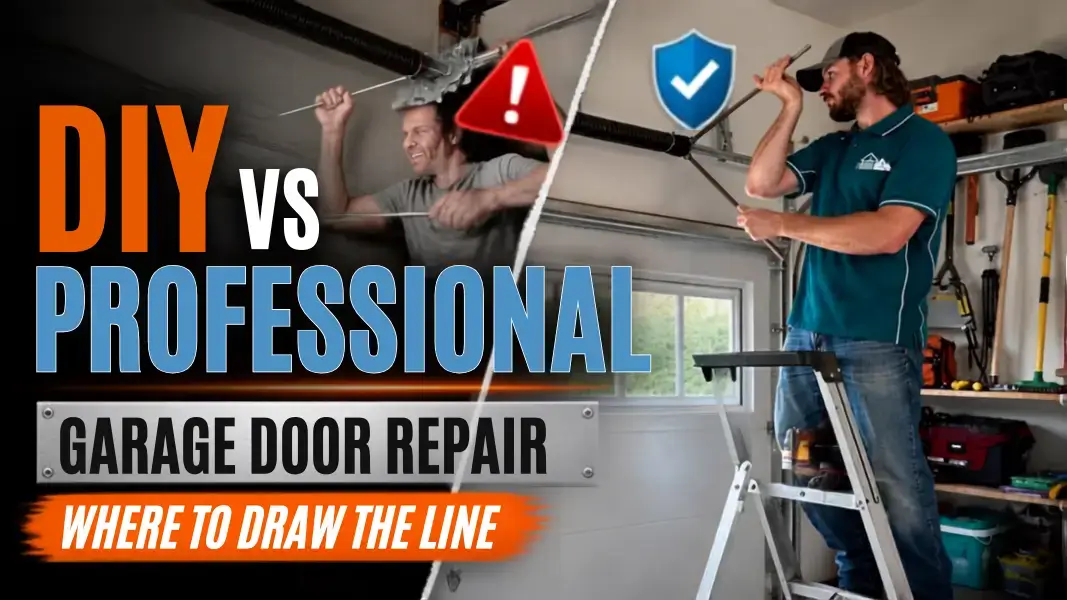
DIY vs Professional Garage Door Repair: Where to Draw the Line
Not every squeak or sticky spot means calling a technician. But guessing wrong on a DIY vs professional garage door repair decision can turn a small fix into a trip to the ER. Plenty of jobs are perfectly safe to handle on your own, and a few are not worth the risk no matter how confident the tutorial video sounds. For the full range of what we handle when a job needs a pro, see our Garage Door repair services.
Safe to Handle Yourself
A handful of garage door tasks are genuinely low risk for a homeowner with basic tools. These are the ones most people can knock out on a Saturday morning:
- Lubricating hinges, rollers, and the opener chain with silicone spray
- Tightening loose bolts and brackets with a socket wrench
- Wiping down and aligning the safety sensor lenses
- Replacing remote or wall control batteries
- Clearing debris from the tracks
- Swapping a worn bottom weather seal
None of these involve stored tension or heavy lifting, which is why they sit firmly on the safe side of this DIY vs professional garage door repair split.
Leave This to a Professional
The other side of the question involves parts that store serious energy or hold the door’s full weight. Get these wrong and the risk goes well beyond a bad repair job.
- Torsion or extension spring replacement
- Cable repair or replacement
- Track realignment after the door jumps off
- Opener motor or gear repair
- Panel replacement, since it usually needs spring rebalancing
Anything involving springs or cables belongs with a trained technician who has the right bars and clamps for the job. Our spring services page covers what that repair actually involves.
Why Springs Are the Hard Line
A torsion spring holds enough stored energy to break bones or worse if it lets go while someone is working near it. This is the one part of a garage door where there is no safe middle ground.
Every year, DIY spring attempts send people to the emergency room, which is exactly why every DIY vs professional garage door repair guide draws the same hard line here. If your door has a broken spring, our cable repair team and spring specialists work as one call, since cables and springs share the same tension system.
The Real Cost of Getting It Wrong
A failed DIY repair rarely stays cheap. A stripped opener gear, a bent track bracket, or a panel pried out of shape often costs more to fix afterward than a professional repair would have cost in the first place.
Add a possible ER visit to that list and the math on a risky repair attempt stops making sense fast. A routine tune-up costs far less than any of those outcomes and catches small issues early.
How to Decide
Ask two questions before picking up a tool. Does the job involve spring tension, cables, or the door’s full weight? Does it require removing anything that is currently under load? A yes to either one means it is time to call a professional instead of pushing forward.
A third question helps too: have you done this exact repair before? A general handy streak does not cover a system holding hundreds of pounds of tension. When in doubt, that is a sign the DIY vs professional garage door repair call should go to a pro.
A simple seasonal maintenance check also catches most small issues before they turn into a repair decision at all.
What a Warranty Can Cost You
A DIY attempt on a covered part can also void the manufacturer’s warranty on the door or opener, even if the repair itself goes fine. That is an easy detail to overlook when a problem shows up on a Saturday and a warranty claim feels like a distant concern.
Checking the warranty terms before reaching for a wrench is a small step that can save a much larger bill later.
Call (833) 435-8883 if you are not sure which side of the DIY vs professional garage door repair line your job falls on. We can walk through it with you and send a technician out the same day if the job needs one.
DIY Garage Door Repair: Your Questions Answered
Know which garage door jobs are safe to try at home and which ones need a professional.
Never DIY Can I replace a garage door spring myself?
No. Springs hold enough stored tension to cause serious injury. This is the one repair with no safe DIY version.
Safe DIY What garage door tasks are actually safe to DIY?
Lubrication, tightening loose bolts, sensor cleaning, battery swaps, and clearing track debris.
Check First Will a DIY repair void my warranty?
It can, depending on the part. Worth checking the warranty terms before starting any repair yourself.
Know the Limit How do I know if a repair is too advanced for DIY?
If it involves spring tension, cables, or anything under load, call a professional.
Pro Value Is a professional repair really worth the cost?
Usually yes. A failed DIY attempt often costs more to fix afterward than the professional repair would have.
Leave the Risky Repairs to a Pro
Springs, cables, and anything under load are not DIY jobs. Call our Denver technicians and we will fix it safely the first time.
Call Now, 24/7 Emergency (833) 435-8883- 4.8 Google Rating
- 28+ Years in Denver
- Fixed Right or We Come Back